
Mold, mildew and musty smells in carpet and couches
A musty smell is a sign of moisture, and the fix is to find the moisture, dry the piece fast and clean it. Mold in carpet usually grows on the backing and the pad, and the EPA says moldy carpet may have to be thrown away; WATERFALL cleans furniture and carpet that smell musty, grew mold or got wet in a leak, and its carpet cleaning takes out the dirt a musty smell lives in. The prices page lists the price of each piece. WATERFALL cleans carpet at your home from $60 a room: call (747) 214-6199.
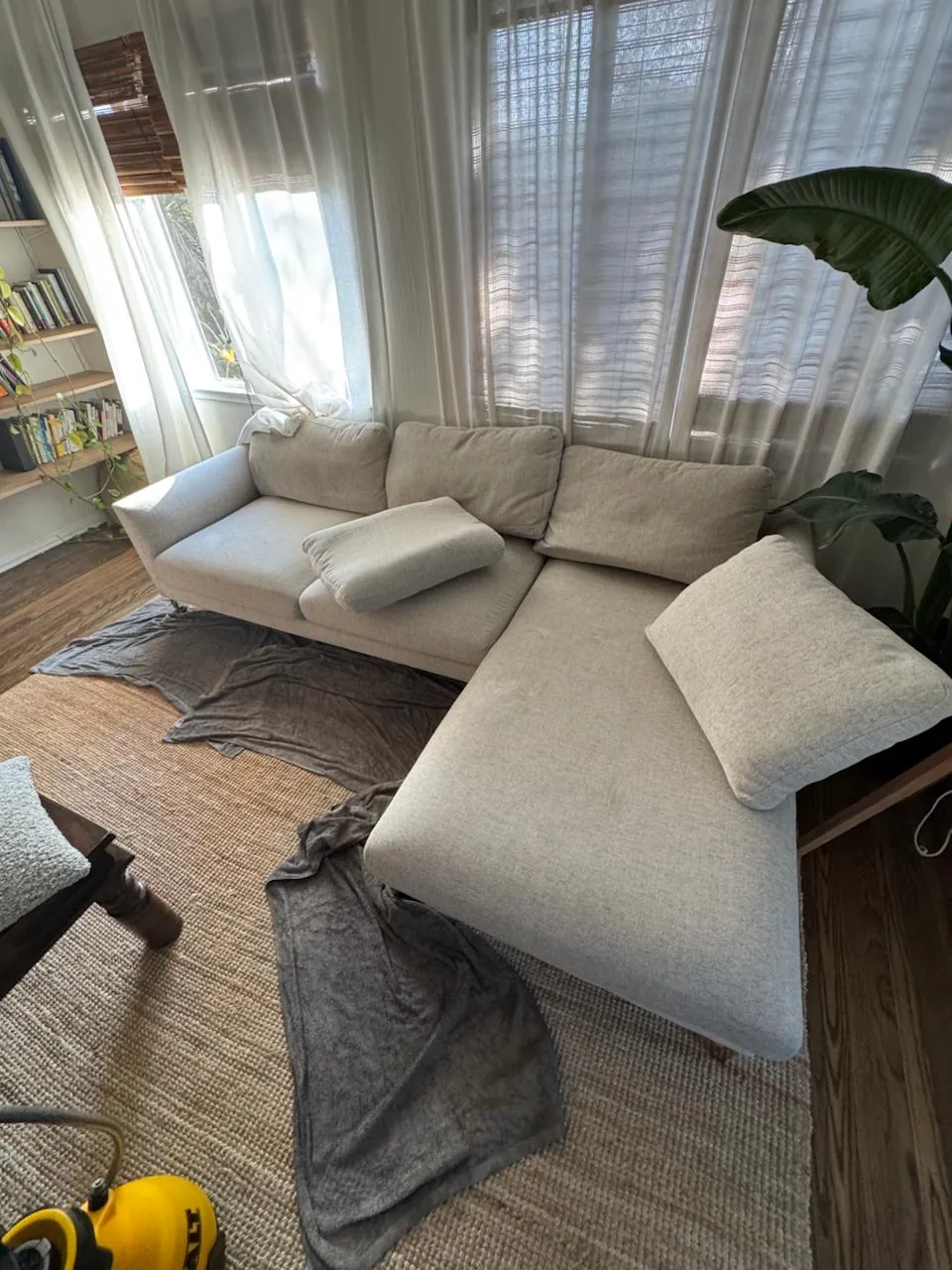
How do you get a musty smell out of a sofa?
Find why it is damp, then dry and clean it. Take the cushions off, open the windows, run a fan on the base and the back, vacuum, and sprinkle baking soda on the fabric and leave it for several hours before vacuuming it up. Keep the room's humidity low while it dries, and read the cleaning code on the tag before you use any liquid.
If the smell is still there when the sofa is fully dry, it is in the cushions or the base, and a deep clean by extraction takes out the dirt the smell lives in. A sofa that smells again whenever it is humid has a moisture source near it: a wall, a balcony door, a leak or a damp room. Foam that still smells musty after drying and cleaning may need replacing.
Why does my couch smell musty even though it looks clean?
Because the smell sits where you cannot see it: in the cushion foam, the fabric backing, the underside of the base, or the wall and floor behind the couch. Old spills, sweat, pet hair and damp air collect there, and a couch against a cold wall or in a humid room stays damp enough to smell.
Take the cushions off, vacuum the seams and the underside, pull the couch away from the wall and run a fan and a dehumidifier, keeping the room's humidity low as the EPA's brief guide to mold and moisture advises. Check the tag under the cushions first: W means water-based cleaning, S means solvent only, W/S means either, and X means vacuum only (cleaning codes). If the smell is back once everything is dry, the cushions need a deep clean; spots or damp foam are a reason to read the mold sections below.
How do you get a musty smell out of furniture?
Air it out in dry, moving air, vacuum it, wipe or clean the surfaces according to the material and let it dry fully before it goes back against a wall. Musty smells come from damp, and wood, fabric and foam all hold it for a long time.
Move the piece a little away from the wall so air can pass behind it, and keep the room dry. Charcoal or baking soda in an open container near the piece absorbs a light smell, while a spray only covers it.
How do you freshen a couch or carpet in a home closed for weeks?
Air it, dry it and vacuum it. A closed, warm home gets stale and damp, and fabric absorbs that smell: open the windows, run fans for several hours, take the cushions off and stand them up, vacuum the couch and use baking soda on the fabric.
If the smell is still there after the air has changed and the couch is dry, a clean by extraction at your home helps; a couch is priced by its number of seats, see prices.
For carpet, run a fan and a dehumidifier until the air feels dry, lift a corner near the walls and windows to check that the pad is dry, vacuum slowly, then leave baking soda on the dry carpet overnight and vacuum again. If it still smells, it needs cleaning by extraction and a fast dry; if the pad is damp or you see growth, read the leak answer below.
How long does it take for the mildew smell to go away from the carpet?
It fades as the carpet dries and airs out, and how long depends on how wet it was and how humid the air is. Once the moisture is gone and the carpet is clean, a surface mildew smell should fade as the air moves through the room.
A smell that is still there after the carpet has been fully dry for several days means moisture or growth in the backing or the pad. Natural remedies such as baking soda and white vinegar help with a light smell and do not reach a damp pad.
How do I get the mildew smell out of an area rug that got wet?
Dry it fast: the EPA's brief guide to mold and moisture says to dry water-damaged items within 24–48 hours. Extract or blot out the water, dry both sides and the floor under it in moving air and shade, and do not put it back until the underside is dry; we clean rugs of every material except viscose, and a rug that stayed wet longer or has growth on the back may have to be replaced.
Take it outside or into a ventilated room, vacuum both sides, check the underside and the floor under it for dampness, and dry it flat in moving air in the shade. Sun fades dye, and a rug left on a damp floor smells again.
A rug that stays musty after it is dry needs cleaning. We clean rugs at your home on a drop cloth (see rug cleaning), and a rug that was wet for a long time may have growth on the back.
Why is there mold on my couch?
Because the couch stayed damp: a spill that was not dried, high humidity, a couch against a cold or leaking wall, or a room with poor air. Mold needs moisture and something to feed on, and fabric, dust and skin oils supply the food.
The fix is to remove the moisture, not only the growth. The EPA's pages say that controlling moisture is the key to controlling mold; see its mold guide below.
How can I tell if the dark spots on my couch cushion are mold or just dirt?
With gloves on, dab the spot with a damp white cloth: dirt is usually flat and sharp-edged and comes off on the cloth, while mold is fuzzy or powdery, spreads in irregular patches, often smells musty, sits where the cushion stayed damp and comes back after cleaning. A home test kit will not settle it.
Spots or patches that are fuzzy, powdery or slimy, white, gray, green, black or dark brown, usually on the underside, the seams or the back against a wall, along with a musty smell. Mildew starts as a flat, light powder that darkens as it spreads.
A dark patch with no smell may be dirt or a stain and not mold. If you are unsure, do not sniff it from close up; look at it in daylight and ask a specialist.
How do you get mold out of a couch?
For a small patch on the surface, take the couch outside, brush off dry growth outdoors with gloves, eye protection and a respirator on, clean the surface according to the fabric tag, and dry it fully in the sun and moving air. For a large patch, or mold in the foam or the frame, the safest step is to discard the piece.
We clean furniture after mold: text a photo and we tell you what we expect. The EPA's mold cleanup page gives the steps and the protective gear, and the point at which a specialist is needed.
Will steam cleaning kill mold on a couch?
Not on its own: we clean furniture after mold, but cleaning is not a health treatment. Mold grows into the fabric, the foam and the frame of an upholstered piece, cleaning the surface does not reach what is inside, and wetting a cushion that is already damp adds moisture.
The EPA's advice is to fix the moisture first; a couch with mold through the fabric and padding is usually replaced, as the answer above says.
How do you clean furniture with mold on it?
Hard surfaces such as wood and metal can be cleaned with detergent and water and dried fully. Upholstered and padded furniture is porous, and mold grows into it, so a piece with mold through the fabric and padding is hard to save.
Never mix cleaners, and never use bleach with vinegar or ammonia, because they produce harmful gases. Wear gloves and a respirator, work in moving air, and stop if the growth is larger than a small area.
How do you remove mildew from upholstery?
A light, surface mildew on a W-coded fabric can be brushed off outside, then the spot blotted with a little diluted white vinegar or detergent in cool water after a hidden-spot test, and dried quickly. Do not soak the cushion.
A mildew smell that returns after it dries means the damp is inside the cushion. At that point it is a moisture problem and not a surface one.
What causes black spots on outdoor cushions?
Mildew, which grows on cushions that stay damp, shaded and dirty: dew, sprinklers, rain, pollen and dust give it moisture and food. Black spots on a white cushion are the common case.
Keep the cushions dry, store them off the ground and let them air after rain. For cleaning outdoor cushions, text first: the guide to ottomans, headboards, recliners and outdoor cushions says what to send.
Can mold grow in carpet?
Yes. Carpet, the backing and the pad hold moisture and dirt, and mold can grow in them after a flood, a leak, a spill that stayed wet or a damp slab. Growth often starts on the underside, where you cannot see it.
How to prevent it: dry wet carpet, the pad and the floor under them within 24–48 hours, as the EPA's brief guide to mold and moisture advises, keep the humidity down and fix the leak.
Can mold growing under wall-to-wall carpet be cleaned?
Usually not reliably. Carpet and its pad are porous and mold grows into the backing and the pad, where cleaning does not reach, so the EPA says moldy carpet may have to be thrown away; the usual fix is to remove the carpet and pad, dry and clean the subfloor and stop the water.
If the carpet got wet recently and nothing is growing yet, it can often be saved by lifting it and drying the carpet, the pad and the subfloor within 24–48 hours, as the EPA's brief guide advises. The EPA puts the area you may handle yourself at about 10 square feet; above that, or after sewage or dirty water, hire a mold specialist. We clean the carpet that is kept afterward.
How do I get a mildew smell out of carpet after a leak in my apartment?
Stop the leak and dry the carpet first; in an apartment, tell the landlord or manager in writing, with photos, right away. The carpet, the pad and the floor under them need to be dry within 24–48 hours, the EPA's window, which usually means lifting a corner, extracting the water and running fans and a dehumidifier.
If the carpet stayed wet longer than that, or there is growth on the back or the pad, the EPA says moldy carpet may have to be thrown away, and the pad goes with it. If the leak is fixed, the carpet is dry and the smell is only in the pile, cleaning by extraction takes out the dirt the smell lives in. We clean carpet after a leak or a flood once the water is stopped, and after mold; carpet is priced per room, see prices.
What does mold on carpet look like?
Discolored patches, often dark, green, gray or white, with a fuzzy or powdery surface, a musty smell, and often growth on the underside of the carpet or on the pad that you only see when you lift a corner. Mildew on carpet looks like a gray or white haze.
A dark line along a wall may be soil from airflow and not mold. A musty smell with a damp floor is a reason to lift an edge and look.
How do you test for mold in carpet?
Start with your eyes, your nose and a damp check: lift a corner in a closet, look at the underside and the floor, and feel whether the pad is damp. If you see or smell mold, the EPA's advice is to deal with the moisture and the growth and not to rely on a test.
A mold specialist can inspect and take samples if you need a record, for example in a rental dispute. A home test kit does not tell you how much mold there is or where.
How do you remove black mold from carpet?
You do not clean it off carpet; you decide whether the carpet can stay. The EPA's guide says porous materials such as carpet may have to be thrown away if they are moldy, and it gives about 10 square feet as the size of an area you may be able to handle yourself.
For a larger area, or if the growth is on the pad or the subfloor, hire a specialist. We clean carpet after mold, but cleaning does not fix the moisture, so fix the leak first.
Is mold in carpet dangerous for kids and pets?
We make no health claim about mold; a question about a child's health is for a doctor, and about a dog's for a vet. The practical step is the same either way: keep children and pets off the area until the moisture is fixed and the carpet is dealt with, since the EPA's advice is to fix the water problem and clean up or remove the moldy material, and moldy carpet may have to be thrown away.
Leave an area larger than about 10 square feet to a specialist, and for a small one wear gloves, goggles and an N-95 respirator, as the EPA's brief guide says.
Is mold on a couch dangerous?
For a health question, ask your doctor. The EPA's mold pages cover what is known, and its practical advice is to remove the source of moisture, clean up small growth carefully and discard soft furnishings that cannot be cleaned.
A moldy couch should not stay in the room where people sleep or sit; move it outside until you decide, and ask a doctor about any health question.
Should I throw away the moldy carpet?
If the growth is on the carpet, the backing or the pad, in more than a small area, or the carpet stayed wet for days, then yes, the EPA says porous materials such as carpet may have to be thrown away if they become moldy. A carpet that smells musty after a spill and is now dry may be only dirty, and can be cleaned.
Replace the pad with the carpet, and fix the moisture first, or the new carpet will grow mold too.
Can mold smell like urine?
A damp, sour smell can come from mold or mildew, and an old pet accident under damp conditions can smell musty as well, so the nose alone does not tell you which it is. Look for visible growth, a damp floor and a source of moisture, and check dry spots with a black light for old urine.
See the guide to pet urine in carpet and rugs for hidden urine, and ask a specialist if you find growth.
How can professionals help get mold out of carpet?
A mold specialist finds where the moisture comes from, contains and removes the affected material and dries the area. That is a different job from cleaning, and the time to call one is when the area is large, the growth is on the pad or the subfloor, or the carpet was flooded.
We clean carpet after mold. The EPA's pages say what to ask a specialist.
Questions and answers
What gets a musty smell out of an old sofa?
Dry it first: cushions off, a fan and a dehumidifier, then vacuum and leave baking soda on the fabric for several hours. If it still smells once dry, a deep clean by extraction takes out the dirt the smell lives in, and foam that stays musty may need replacing.
How do I get rid of the bad smell from my couch?
Lift the cushions to find the source, vacuum, clean the area and dry the piece quickly. A spray only covers a smell.
Why does my couch smell musty?
Moisture is in the fabric or foam, from a spill that stayed wet, humidity or a damp room. Dry the room and the piece.
How to remove mold from a couch?
Fix the moisture first, and for visible mold ask a specialist; a moldy couch is often replaced. We clean couches after mold: text a photo and we tell you what we expect.
How to get a mildew smell out of a rug?
Dry the rug fast with air moving, vacuum, and clean it; WATERFALL cleans rugs with a musty smell. If the smell stays after drying, text a photo to (747) 214-6199.
What does mold on a couch look like?
Dark or fuzzy spots, usually where the fabric stayed damp. We clean couches after mold: text a photo and we tell you what we expect.
Is carpet mold dangerous?
Ask a doctor about any health question; the practical step is to fix the moisture and keep people and pets off the area. The EPA's guidance linked on this page says moldy carpet may have to be thrown away.
How to test for mold in carpet?
A musty smell and dark spots are signs, and a specialist can test. We clean the carpet after mold: text a photo and we tell you what we expect.
How to clean furniture with mold?
We clean furniture after mold: text a photo and we tell you what we expect. Fix the damp first, and a mold specialist can say whether the piece is worth saving.
Prices and booking
More guides
- Odors and smells: all guides
- Pet urine and accidents in carpet and rugs — Blot, flush with cool water, use an enzyme cleaner, and dry it fast; urine that reached the pad is the part a surface clean misses.
- How to deodorize a couch or rug — Find the source, pretreat it, flush it out and dry fast; enzymes break down organic matter, and a scent on its own covers a smell rather than removing it.
- Smoke and chemical smells in a couch — Cigarette and fire-pit smoke sits in fabric and comes out partly with ventilation and a deep clean; a new couch or carpet smell fades with fresh air; fire and wildfire damage is for a specialist.
- Dust mites, bed bugs and mold in a mattress — Dust mites are tiny and common in beds and are kept down by covers, hot washing and low humidity; bed bugs and mold need their own specialists.
Sources: EPA on mold (The EPA's guidance on mold and moisture in the home.); EPA on mold cleanup (The EPA's steps for cleaning up mold and drying a home after water damage.); EPA brief guide to mold and moisture (The EPA's short guide: dry water-damaged areas within 24-48 hours, cleanup of areas under about 10 square feet, and what to wear.)